Why Is Oil Steady While Gold Crashes?
The Gold/Dollar/Oil Trinity.

Something strange is happening in crude oil prices, particularly WTI ($CL=F). Headlines abound about the potential for $150 or even $200/barrel oil. But WTI has yet to break the $100 threshold, despite nearly touching it several times over the past 10 days. There seems to be a hard resistance just below $100. So despite the breathless headlines of an “OIL SHOCK!!!”, one question I keep hearing being asked is, “Why is oil not surging?”
There is another question, seemingly unrelated, but which was also raised over the past 10 days: “Why is gold crashing?” There are many speculative answers, none of them especially convincing. The Fed’s decision to keep rates steady in the face of a hot inflation print is the most common response, but that was a decision that had a 99%+ consensus leading to the announcement. There was absolutely no shock to the market whatsoever that would precipitate such a huge drop in the gold price.
The strange coincidence is most strange when we think of gold and oil as commodities which are valued in US dollars. Oil should definitely be surging, and gold holding either steady or actually appreciating as a geopolitical ‘safe' haven’ asset. Neither are happening.
Perhaps the framing of gold and oil as dollar-priced commodities is hiding the simpler truth. Gold and oil exist at the extreme ends of the commodity spectrum. Gold has little to no practical use beyond being a store of wealth, and all gold that is mined is preserved essentially forever. Oil, on the other hand, becomes a massive liability when it’s stored, and is pumped at a rate roughly equal to the rate that it is burned or processed.
If the global economy were a living body, gold would be immobile fat stores, while oil would be readily-accessible glucose streaming throughout the body. In the event of an “oil supply shock”, gold (fat stores) is quickly converted into new oil production (blood sugar) in order to preserve the functioning of the overall system. In order to transform gold into new oil production, the gold must first be converted into the primary international exchange currency — US dollars — and then into oil purchases.
Out of this trinity of gold (as store), oil (as energy), and US dollars (as the exchange medium), it should be oil that changes in value, while gold and the US dollar maintain their usual price relationship. If we look at the time span across the invasion of Ukraine in Feb. ‘22, we can see this in action with oil in terms of its price both in US dollars and gold:
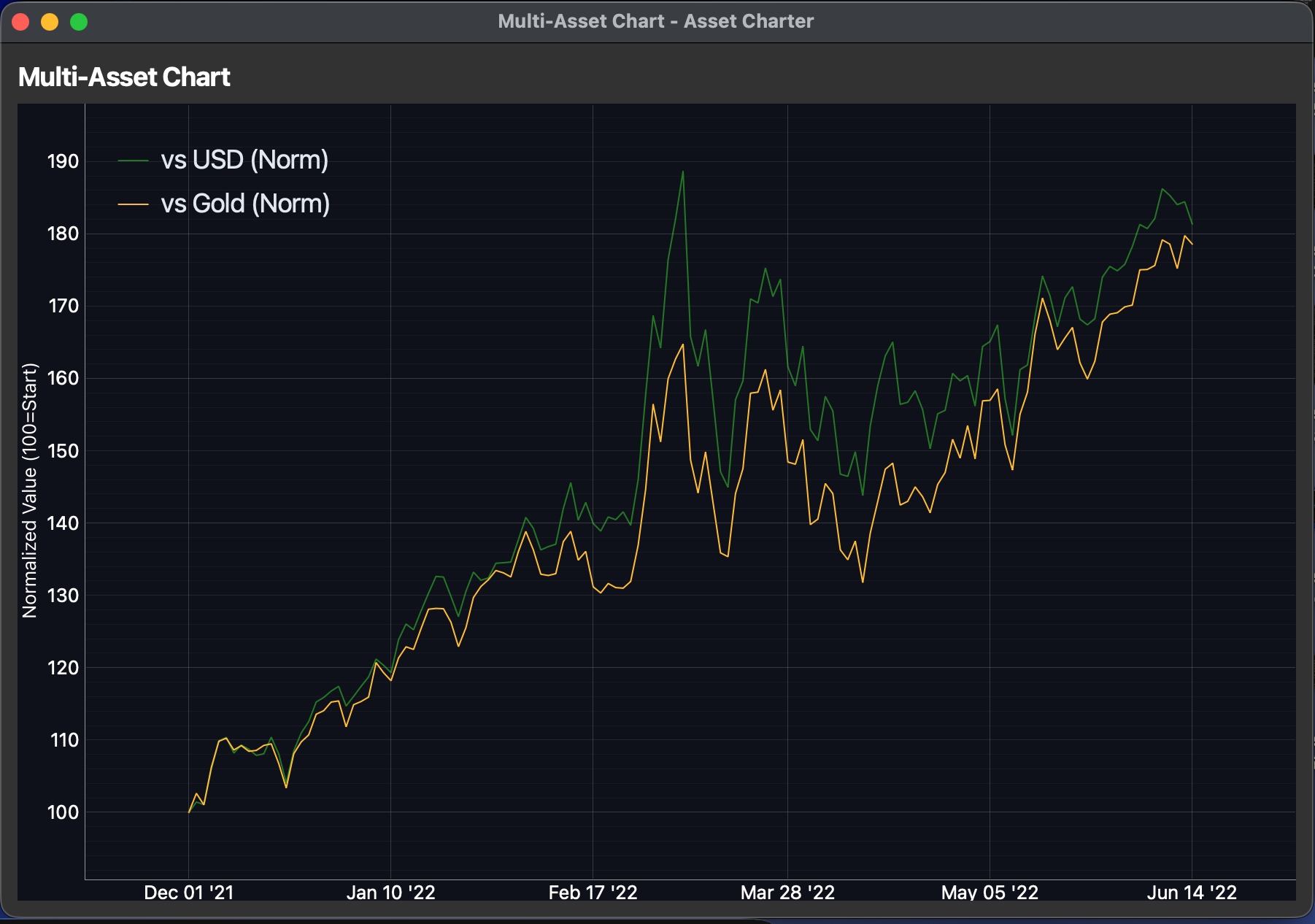
The price of oil in terms of both USD and gold is relatively in lock-step, with the price in gold being somewhat more muted than in USD, but essentially correlated 1:1 over the course of the war’s beginning.
The same picture across the Iran war, however, shows a very similar pattern — a very large initial spike, which immediately drops back, then a return to a rapid and steady rise back up — but then suddenly there is noticeable divergence:
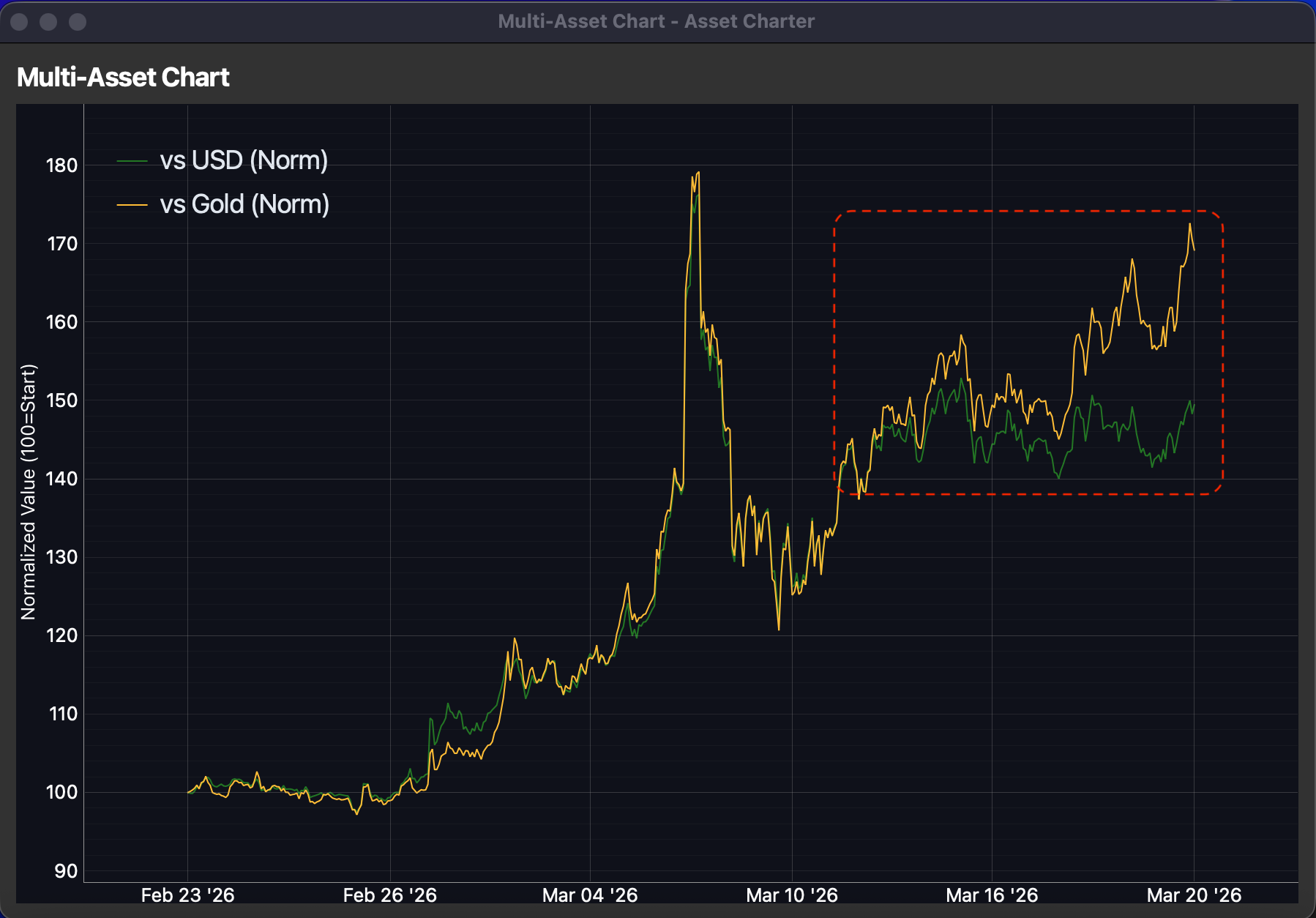
While oil priced in gold continues the pattern we saw during the Ukraine invasion — a volatile but unmistakeable rise — the price of oil in USD is chopping sideways and even falling ever so slightly.
This is of course expected from the crash in gold prices, but what I think this chart suggests is that oil is in fact surging in price despite its steady market price. The usual relationship between gold and oil is holding steady; this time it is the US dollar which is behaving unusually.
While the fog of war makes any conclusions impossible about why this is happening, at a grand level this war could be seen as the forceful re-imposition of the petro-dollar system. The US dollar is rising alongside oil via sheer geopolitical force, at the expense of gold. The effect of this war so far has been to force the liquidation of gold in order to secure oil supplies. However the mechanism for this inversion is being implemented, the effect is to punish any country that has shifted its central bank reserve away from the US dollar and towards gold.
Prime targets then would be BRICS countries, and especially China. But also, the entire world at large. Note, it is entirely possible the US Treasury + Federal Reserve are using the ESF and gold swaps and other secretive ‘currency stabilization’ techniques to reverse the massive secular shift towards gold.
I currently have no prediction of where any of oil, gold, or the US dollar goes from here. I’m just making observations and conjectures.
*******
NONE OF THIS IS INVESTMENT ADVICE, I AM NOT SUGGESTING ANY TRADES OR INVESTMENTS, I’M SIMPLY THINKING THROUGH MY OWN PERSONAL INVESTMENT STRATEGIES TO HELP ME WORK THROUGH SOME SCENARIOS AND SHARING THEM IN HOPES YOU MIGHT GIVE ME SOME IDEAS IN THE COMMENTS, FOR WHICH I WILL SIMILARLY NOT HOLD YOU ACCOUNTABLE!
Thank you for posting this.